
Cost of Hiring a Software Developer in 2026: US, Canada, Australia and Bangladesh
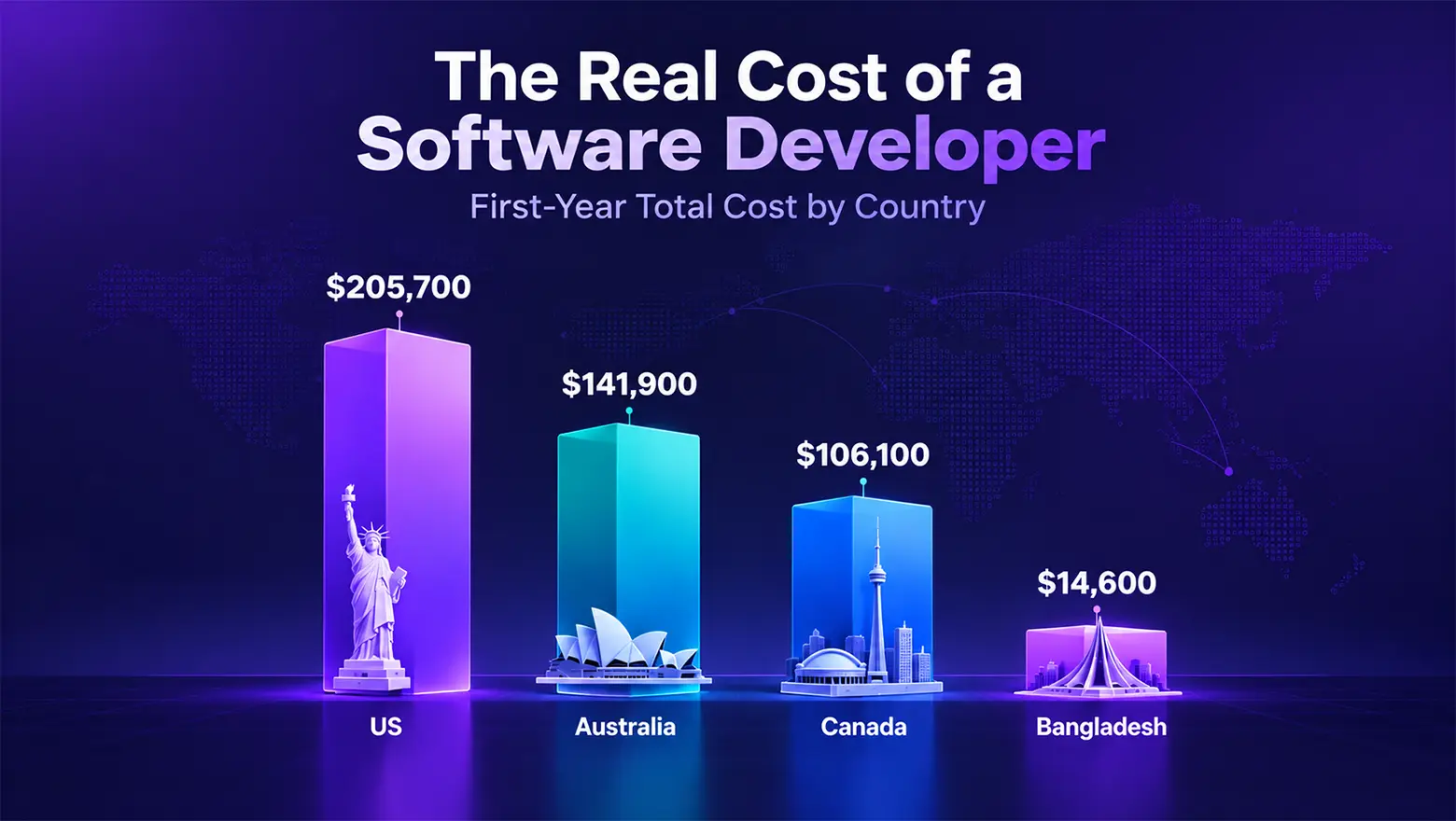
A software developer’s salary is the smallest number in the budget. Add employer taxes, benefits, a recruiter’s fee, a laptop and the manager’s time, and the first-year cost of one hire runs well above the figure on the offer letter. This guide compiles published data for four markets, shows the arithmetic and lists every assumption, so a finance lead can change an input and check the result. It was last updated on 7 October 2026 and is refreshed every quarter.
TL;DR
On a first-year, fully loaded basis, one developer costs roughly US$205,700 in the US, US$141,900 in Australia, US$106,100 in Canada and US$14,600 in Bangladesh.
Salary is only 52% to 66% of that first-year total. Recruitment, equipment, benefits, payroll costs and management make up the rest.
The Bangladesh figure is what a local employer pays. A foreign company also pays for an entity, an employer of record or a vendor, so treat it as a floor and not a quote.
How much does it cost to hire a software developer in 2026?
One developer costs about US$205,700 in the first year in the US, US$141,900 in Australia, US$106,100 in Canada and US$14,600 in Bangladesh. Over three years the same hire costs roughly US$557,600, US$384,600, US$285,200 and US$35,700. The figures come from the model explained below.
Market | First-year total | Ongoing annual cost | Three-year total |
|---|---|---|---|
US | $205,675 | $175,979 | $557,633 |
Australia | $141,917 | $121,334 | $384,585 |
Canada | $106,117 | $89,556 | $285,229 |
Bangladesh | $14,567 | $10,552 | $35,671 |
Three-year totals assume no pay rises and no turnover. Figures are in US dollars, rounded, at the exchange rates in the next section.
What is a software developer’s base salary in each market?
The published median base salary is about US$136,000 in the US, US$70,300 in Canada, US$90,400 in Australia and US$7,600 in Bangladesh. The sources differ in method and year, so read the table as a comparison of scale and not a precise ranking.
Market | Published figure | Source and date | Annual, local currency | Annual, US$ |
|---|---|---|---|---|
US | Median pay, software developers | US Bureau of Labor Statistics, May 2025 data | $135,980 | $135,980 |
Canada | Median wage, software developer (NOC 21232), C$48.08 an hour | Job Bank Canada, updated 19 Nov 2025 | C$100,006 at 2,080 hours | $70,304 |
Australia | Median full-time weekly earnings, software and applications programmers, A$2,496 | Jobs and Skills Australia, ABS data, February 2025 | A$129,792 | $90,413 |
Bangladesh | Average base pay, senior software engineer | Payscale, 27 profiles, updated 14 Feb 2026 | ৳929,032 | $7,573 |
Exchange rates, from Pound Sterling Live on 6 to 7 October 2026: 1 USD = 122.674 BDT, 1 AUD = 0.6966 USD, 1 CAD = 0.7030 USD.
Two warnings apply. The US, Canadian and Australian numbers are medians across all experience levels, so a genuine senior hire costs more than shown. The Bangladesh figure is a senior salary, so the comparison is deliberately unfavourable to Bangladesh. We also found no government salary series for Bangladesh, and Payscale’s range there is very wide (৳48,000 to ৳3,000,000), so treat it as a guide.
What factors change the cost of hiring a developer?
Five factors move the cost most: where the developer lives, their seniority, the technology, how long you keep them and how you engage them. The model fixes the first and averages the rest, so it shows the shape of the gap and not your exact bill.
How much does geography matter?
It matters more than anything else. The same job costs US$7,600 a year in salary in Bangladesh and US$136,000 in the US, an 18-fold gap before any other cost is added. Geography also decides the payroll rules, because statutory costs run from about 6% to 17% of salary across the four markets.
How much do seniority and industry add?
Seniority moves the number more than most buyers expect. The BLS reports that the lowest-paid 10% of US software developers earned under $82,460 and the highest-paid 10% over $214,670, a spread of more than 2.5 times inside one country. Industry matters too: the BLS median in software publishing is $164,550, about 21% above the all-industry figure.
Does the technology stack change the price?
Probably, but we cannot put a number on it. The government sources above do not split pay by language or framework, and the Bangladesh data is too thin to do so. Scarce skills such as machine learning tend to command a premium. Ask for a quote by stack before you budget.
Does the length of the commitment change the cost?
Yes, because recruitment and equipment are one-off costs spread over the time you keep the person. In the US, those two items are 14% of the first-year total but only 5% of a three-year total. In Bangladesh they are 28% of the first year and 11% of three years. A short engagement carries the heaviest overhead.
Which engagement model costs what?
The model prices one direct employee, and the other routes shift where the cost sits and who carries the risk. No source we found publishes comparable rates for all four routes, so the table is qualitative.
Route | What you pay | Cost shape | Who carries the risk |
|---|---|---|---|
Direct employee | Salary, payroll costs, benefits, recruitment, equipment, management | Fixed, front-loaded | You |
Agency or vendor team | A monthly or project rate that includes the vendor’s overhead and margin | Variable, stoppable | Shared; depends on the contract |
Employer of record | Local salary plus a service fee | Fixed, plus a fee | The provider carries employment compliance; you direct the work |
Freelancer | An hourly or fixed rate, with no benefits | Variable | You, for continuity and quality |
Our guide to custom software development cost covers the other way to buy software: pricing a project instead of hiring a person, and outsourcing SaaS development explains how to contract a vendor safely.
What does an employer pay on top of salary?
Employers add between about 6% and 17% in statutory costs, plus benefits, depending on the country. In the US it is payroll tax, in Canada pension and insurance contributions, in Australia compulsory superannuation, and in Bangladesh mostly festival bonuses.
Market | Statutory employer cost | Source | As a share of salary |
|---|---|---|---|
US | Social Security 6.2% and Medicare 1.45% | IRS, 2026 | 7.65% |
Canada | CPP 5.95% up to C$4,230.45; EI up to C$1,572.30 | CRA CPP and EI, 2026 | 5.8% |
Australia | Superannuation guarantee, 12% | 12% | |
Bangladesh | No employer payroll tax; two festival bonuses a year, each about one month’s basic salary | Up to 16.7% |
The Bangladesh bonus rule is described differently by two vendor guides: one says each bonus is about one month’s basic salary, the other says half of monthly gross salary. The model uses the higher figure, so the Bangladesh cost is not understated [VERIFY: confirm against the Bangladesh Labour Act text].
Benefits come on top of this. We assume a uniform 10% of salary for health cover and other benefits in all four markets. This is a placeholder, and probably too low for the US: the BLS reports that benefits made up 31.5% of full-time private-sector compensation in June 2026, although that figure includes paid leave and legally required costs. Using 10% makes the US look cheaper than it is, which keeps the comparison conservative.
What do recruitment, equipment and management add?
In the three Western markets, recruitment, equipment and management together add about a third of the salary in the first year. None of the three appears in a salary survey, and none is optional.
Recruitment. Agency fees for technical roles typically run 15% to 30% of first-year salary, according to Dover, a recruiting vendor. That is a vendor’s range, not an audited survey. The model assumes 20% in every market. A self-run search costs less in cash but takes engineering time.
Equipment. A laptop, monitors, software licences and a security setup. The model assumes US$2,500 per hire in every market, which is our estimate and not a published figure.
Management overhead. Someone has to onboard, review code, plan work and hold one-to-ones. The model assumes this takes the equivalent of 10% of the developer’s loaded annual cost.
These assumptions are the weakest part of the model, so they sit in one place:
Assumption | Value used | Basis |
|---|---|---|
Hours worked per year | 2,080 | 40 hours × 52 weeks, used only for the Canadian hourly wage |
Other benefits | 10% of salary | Uniform placeholder in all four markets |
Recruitment fee | 20% of salary, first year only | Mid-point of Dover’s 15% to 30% |
Equipment | US$2,500, first year only | Our estimate |
Management overhead | 10% of loaded cost, every year | Our estimate |
What is the full cost of one developer in each country?
The first-year cost of a developer comes to about US$205,700 in the US, US$141,900 in Australia, US$106,100 in Canada and US$14,600 in Bangladesh. The US costs roughly 14 times the Bangladesh figure, Australia about 10 times and Canada about 7 times.
Cost item (US$) | US | Canada | Australia | Bangladesh |
|---|---|---|---|---|
Base salary | 135,980 | 70,304 | 90,413 | 7,573 |
Statutory employer costs | 10,402 | 4,079 | 10,850 | 1,262 |
Other benefits (10%) | 13,598 | 7,030 | 9,041 | 757 |
Loaded annual cost | 159,980 | 81,414 | 110,304 | 9,593 |
Recruitment (20%, year one) | 27,196 | 14,061 | 18,083 | 1,515 |
Equipment (year one) | 2,500 | 2,500 | 2,500 | 2,500 |
Management overhead (10%) | 15,998 | 8,141 | 11,030 | 959 |
First-year total | 205,675 | 106,117 | 141,917 | 14,567 |
Ongoing annual cost | 175,979 | 89,556 | 121,334 | 10,552 |
Three-year total | 557,633 | 285,229 | 384,585 | 35,671 |
Team of five, first year | 1,028,375 | 530,585 | 709,585 | 72,835 |
Figures are rounded and calculated at the exchange rates above. Ongoing cost excludes recruitment and equipment. The three-year total is the first year plus two ongoing years. A fixed US$2,500 for equipment is almost 17% of the Bangladesh first-year figure and under 2% of the US one, which is one reason to read the totals as ranges and not exact prices.
How much do the assumptions change the answer?
Moving the two softest assumptions, benefits and the recruitment fee, lowers the first-year total by about 3% in a low case or raises it by up to 21% in a high case, but it does not change the order of the four markets.
First-year total (US$) | Low: 10% benefits, 15% fee | Base: 10% benefits, 20% fee | High: 30% benefits, 30% fee |
|---|---|---|---|
US | 198,876 | 205,675 | 249,188 |
Australia | 137,396 | 141,917 | 170,849 |
Canada | 102,601 | 106,117 | 128,613 |
Bangladesh | 14,188 | 14,567 | 16,990 |
The US spread, about $50,000 from low to high, is more than three times the entire first-year cost of a Bangladeshi hire. Change any input in the downloadable model and the totals move, but the ranking holds.
What hidden costs do most budgets miss?
Five costs rarely appear in a salary comparison: replacing a leaver, severance, ramp-up time, time-zone friction and the legal wrapper around a foreign hire. They do not break the comparison, but they matter when the gap between options is smaller than it is here.
Replacing a leaver. A departure triggers a second recruitment fee and a second ramp-up in every market.
Severance. In Bangladesh, termination severance is one month’s pay for each year of service, according to Payoneer.
Ramp-up. A new developer is not fully productive on day one, and the manager’s time is the cost. The model’s 10% management line covers only part of it, and the developer hiring timeline shows how long the wait before that point can be.
Time zones. Dhaka is UTC+6, so a US team gets little or no shared working time, while Europe and Australia get a few hours. Coordination has a cost that salary data does not show.
The legal wrapper. A foreign company needs a local entity, an employer of record or a vendor. Each adds fees and changes who carries the risk.
Should you hire in-house, use an agency or build an offshore team?
Hire in-house when the work is core to your product, use a local agency when the project has an end date, and consider an offshore team when the roadmap is long and you can manage across time zones. The cost table informs the choice but does not make it.
In-house: you need constant context, the work is core and you can afford a full first-year cost.
Local agency: the project has a clear end date and you value delivery speed more than a long-term team.
Offshore team: the roadmap is long, the budget is tight and you have a technical lead who can manage the time-zone gap.
For the middle path, our guide to software team augmentation explains how external developers join an existing team, and how to build a software development team covers the roles to hire first. If you are still choosing a model, read in-house vs outsourcing vs staff augmentation. For Australian buyers, see offshore development for Australian companies, and to compare Bangladeshi firms, see our list of software companies in Bangladesh.
What should you ask before you compare developer costs?
Ask what each number includes before you compare it with another. Salary, take-home pay, loaded employer cost and an agency’s bill rate are four different things, and comparing one with another is the most common error in a hiring budget.
Is this figure base salary, take-home pay, loaded employer cost or a bill rate?
Does it include recruitment, equipment and management time?
Which seniority and which stack does it describe?
In which currency, and on what date was it converted?
Who is the employer of record, and who owns the code?
What is the notice period, and what does ending the engagement cost?
What is the minimum commitment, and what happens if you scale down?
What can this comparison not tell you?
The gap is real, but it is not a saving you can bank. It shows what an employer in each country pays, not what you will pay for a Bangladeshi developer working for your company.
Seniority is not equal. A Bangladeshi senior engineer and a US median developer are different people on different career paths, so the table is not a like-for-like capability comparison.
Vendor rates are higher than salaries. A vendor’s monthly rate will be a multiple of the salary shown.
Quality varies. The spread within each country is wider than the spread between the medians.
Work from the table to a shortlist, then test with real quotes and a small pilot.
Frequently asked questions
What is the average salary of a software developer in the US?
The US Bureau of Labor Statistics reports a median of $135,980 for software developers in May 2025. The lowest 10% earned under $82,460 and the highest 10% earned over $214,670. Pay is higher in software publishing, where the median is $164,550.
Is it cheaper to hire a software developer in Canada than in the US?
On published medians, yes. A Canadian software developer’s median wage of C$48.08 an hour is about US$70,300 a year at 2,080 hours, against $135,980 in the US. The model puts a Canadian first-year cost at about US$106,100, roughly half the US figure.
How much does a recruiter charge for a software developer?
Agency fees for technical roles typically run 15% to 30% of first-year salary, according to Dover, a recruiting vendor. On a $120,000 salary, a 20% fee is $24,000. Fractional or hourly recruiters can cost less for some roles.
What does it cost to hire a developer in Bangladesh as a foreign company?
It costs more than a local salary, because you pay for a local entity, an employer of record or a vendor. The model’s US$14,600 first-year figure is what a Bangladeshi employer pays for a senior engineer. Ask any vendor for a written monthly rate and what it includes.
What is total cost of employment?
Total cost of employment is everything an employer pays to have a person on staff: salary, payroll taxes, benefits, recruitment, equipment, training and management time. In the model above, the first-year total is 1.5 to 1.9 times the base salary, depending on the country.
How often is this page updated?
We update it every quarter. Salary sources refresh on different schedules: BLS in the spring, Job Bank when its wage tables change, and exchange rates daily. Each update re-checks the sources, the exchange rates and the assumptions.
Conclusion
The first-year cost of a developer varies by roughly 14 times across these four markets, and the salary is only part of it. Use the tables, change the assumptions to match your company, and get real quotes before you decide.
If you want a quote for a dedicated team in Bangladesh, Vista SysTech’s team augmentation service is one option among the firms in our list.
Have a project like this?
We help teams turn ideas like the one above into shipped, dependable software. Let’s talk.
Schedule a call