
Developer Hiring Timeline in 2026: How Long Each Stage Really Takes
You posted the role in the summer and the seat is still empty. Nothing is wrong with your process. A realistic developer hiring timeline runs about three months from job post to first day, and the longest stretch is often one you do not control: the candidate’s notice period.
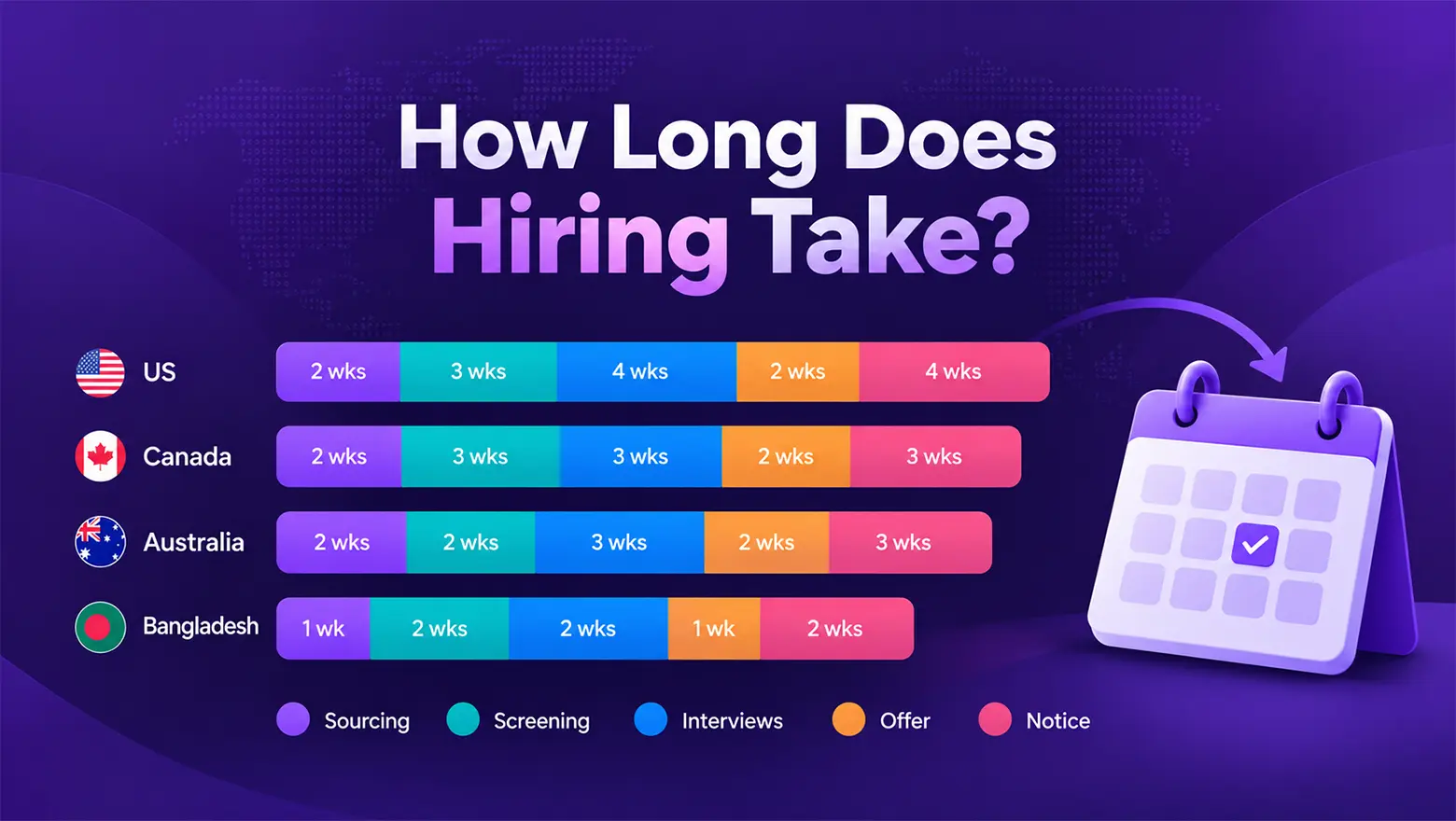
This article breaks the timeline into its five stages, shows which numbers are measured and which are estimates, and compares the US, Canada, Australia and Bangladesh.
TL;DR
Filling an engineering role takes about 62 days on average (Gem, 2026), roughly nine weeks.
Add a notice period and the real wait from the job post to the first day is about 11 to 13 weeks in the US, Canada and Australia, and 11 to 17 weeks in Bangladesh.
Sourcing and notice are the two stages you cannot compress by being efficient. Interviews and offers are where delay is self-inflicted.
How long does it take to hire a developer from start to finish?
Gem’s 2026 recruiting benchmarks, as reported by noon.ai, put the average time to fill engineering and technical roles at 62 days, the slowest of any function. That covers posting to accepted offers. The candidate still has to leave their current job.
Older data points the same way. Glassdoor’s 2017 study of 83,921 interview reviews found a US software development engineer spent 40.8 days in the interview process alone, and Canada averaged 20.1 days across all jobs. Those figures are self-reported and nine years old, so treat them as a floor rather than a forecast.
Here is how the stages add up. Ranges marked “estimate” are editorial planning figures. No published, comparable data exists for each stage that we could find.
Stage | Typical duration | Basis |
|---|---|---|
Job post and sourcing | 2 to 3 weeks | Estimate |
Screening | About 1 week | Estimate |
Interviews | 3 to 4 weeks | Estimate, consistent with Glassdoor’s 40.8 days for application to offer |
Offer and negotiation | 1 to 2 weeks | Estimate |
Subtotal: post to accepted offer | About 9 weeks | Gem 2026: 62 days |
Notice period | 2 to 8 weeks, by market | Law and contract, see below |
The subtotal is the sourced anchor. The individual stage splits are estimates, scaled to fit it.
What happens at each stage of the developer hiring process?
Hiring a developer runs through five stages in a fixed order: job post and sourcing, screening, interviews, offer, and notice period. Each has its own owner, a normal duration and a usual point where it stalls. The durations below are estimates unless a source is named.
What happens during job posting and sourcing?
Sourcing is the stage where you write the role, publish it and search for candidates, and it usually takes two to three weeks for a mid-level developer (estimate). The hiring manager owns the job description and the channels, and the stage ends when you have enough qualified applicants to start screening.
Where it stalls
A vague job description attracts the wrong applicants and hides the right ones. A single channel, such as one job board, narrows the pool. Senior and specialist roles take longer, because the best candidates are usually employed and not browsing, so you may need to approach them directly.
What to watch
Count qualified applicants after the first week, not total applicants. If the number is low, change the description or the channel before waiting another fortnight.
Why does screening stall?
Screening is the first filter: someone reads applications, runs a short call and decides who moves forward. It takes about a week when one person owns it (estimate), and it stalls when nobody does. A recruiter, an engineering manager or a founder may each assume another is reading the queue.
Where it stalls
Applications sit unread, calls are booked days apart, and the shortlist waits for a manager who is in sprint planning. A candidate with several active applications can accept another offer while yours is still in the queue.
What to watch
Name one owner and a response time for every application, for example two working days from receipt to a yes or no.
What makes developer interviews run long?
Interviews take three to four weeks for two to four rounds (estimate). Glassdoor’s 2017 figure of 40.8 days for a US software development engineer covers application through offer, which spans screening, interviews and the offer stage together. It is consistent with this range, and it shows the total can run longer.
Where it stalls
Each round costs the interview itself plus scheduling and feedback, and the gaps between rounds are where weeks disappear. Panels are hard to book, and feedback arrives late. A take-home test adds days that candidates are rarely willing to spare, especially those who are employed.
What to watch
Count the days between rounds, not the rounds. Three rounds with a two-day gap each take less time than two rounds with a week between them.
Where do candidates get lost between interview and offer?
The offer stage covers the final decision, internal approval, the written offer and the candidate’s reply. It takes one to two weeks (estimate). Most of that time is approval inside your company and the candidate’s own thinking time.
Where it stalls
The salary range is not agreed until after the final interview. The approver is travelling. The candidate asks for changes and the loop restarts. A slow offer costs more than a slow interview, because by this point the candidate may be weighing a second offer.
What to watch
Get the salary range signed off before the search starts, and give the offer verbally within a day of the final interview, with the written version following.
What makes the notice period different from every other stage?
The notice period is the time between an accepted offer and the first day, and it is the only stage your process cannot shorten. It runs from about two weeks to two months, depending on the country and the candidate’s contract. The next section gives the rule for each market.
Where it stalls
Nothing stalls, because the delay is fixed by law or contract. The risk is that the candidate is still employed, so a counter-offer can reach them before they start.
What to watch
Stay in contact during the notice period with a short note or a team introduction. You can also ask whether the current employer will release the candidate early, though you cannot rely on it.
How does the developer hiring timeline differ by market?
The first four stages look similar everywhere. Notice periods are where the markets pull apart, as the table shows.
Market | Notice rule | Typical wait | Post to first day |
|---|---|---|---|
United States | No federal requirement for the employee to give notice; terms follow the contract | About 2 weeks by custom (estimate) | About 11 weeks |
Canada | No resignation-notice requirement under Ontario’s Employment Standards Act | About 2 weeks, usually by contract | About 11 weeks |
Australia | Set by the employee’s award, contract or registered agreement | Commonly 2 to 4 weeks (estimate) | About 11 to 13 weeks |
Bangladesh | Labour Act 2006, section 27: 60 days for permanent workers, 30 for monthly-rated, 14 for others; managerial staff follow their contract | 2 to 8 weeks | About 11 to 17 weeks |
The “post to first day” column adds the 9-week anchor to the notice range. It is a derived figure, not a measured average.
Sources behind the notice column: the US Department of Labor says a termination that is not unlawful is subject only to the private contract between employer and employee. A legal guide on Ontario resignation says the Employment Standards Act sets no minimum, and that two weeks is the usual contract term. The Fair Work Ombudsman says an award, contract or agreement sets how much notice an Australian employee gives. For Bangladesh, a Daily Star legal column sets out the 60, 30 and 14 day periods and notes managerial staff follow their own terms. Check the contract before you rely on these numbers; this is not legal advice.
Where do the weeks go, and what can you control?
Most avoidable delay sits in four places: slow feedback, scheduling gaps, long assessments and slow offer approval. Fixing them can plausibly save two to three weeks (estimate). Notice and the length of the market search stay as they are.
Feedback: agree on a 24-hour rule after every interview.
Scheduling: hold interview slots before the candidates are chosen.
Assessments: keep any take-home test under two hours, or replace it with a live session.
Approval: get the salary range signed off before the search starts.
The guide to how to build a software development team covers which roles to hire first, so the search is shorter. For a view of the total cost of waiting and hiring, see the cost of hiring a software developer. And if the real question is whether to hire at all, in-house vs outsourcing vs staff augmentation compares the three routes.
What does a two-week start look like?
If a role cannot wait three months, adding developers through staff augmentation changes the arithmetic. Vista SysTech can usually start within about two weeks of agreeing scope, because the developers are already on our team, so no notice period applies.
Compared with the timeline above:
Direct hire | Staff augmentation | |
|---|---|---|
Time to first day | About 11 to 17 weeks | About 2 weeks |
Notice period | 2 to 8 weeks | None |
Who manages the developer | You | You |
Commitment | Permanent contract | Monthly, stoppable |
You still run the sprints and review the code, so a tech lead needs time to direct the work. Augmentation also does not give you a permanent employee who holds the product knowledge. If the role is the core of your product, hiring directly is still the better answer. The guide to software team augmentation explains how it works, and if you want a pilot, you can hire dedicated developers from Bangladesh on a monthly basis.
Frequently asked questions
What is the average time to hire a software engineer?
About 62 days from job post to accepted offer for engineering roles, according to Gem’s 2026 benchmarks as reported by noon.ai. Add the notice period and a first day arrives roughly 11 to 13 weeks after the post in most Western markets.
Why does hiring a senior developer take longer?
Senior developers are usually employed, receive several approaches and can wait for the right offer. You search a smaller pool, interviews run deeper and negotiation takes more rounds. Plan for the upper end of every range in this article.
Can you shorten a developer’s notice period?
Sometimes. A candidate can ask the current employer to release them early, or you can offer to buy out part of the notice. Neither is guaranteed, and in Bangladesh the Labour Act allows payment in lieu of notice in some cases, so ask the candidate to check their contract.
How long does it take to hire a developer in Bangladesh?
Expect roughly 11 to 17 weeks from job post to first day. The hiring stages take about as long as anywhere else, and the notice period adds 2 to 8 weeks. No published dataset gives a Bangladesh-specific hiring average, so this figure is derived from the stages and the Labour Act.
What is the difference between time to fill and time to hire?
Time to fill counts from the day the role opens to the day an offer is accepted. Time to hire counts from the day a specific candidate enters the process to the same moment. Time to fill is longer, because it includes sourcing before anyone applies.
Conclusion
Start with the role in front of you, not the average. Use the table above to add up your own timeline: sourcing and screening, interviews, the offer, then the notice period in the country where your candidate lives. That gives you an expected first-day date.
Next, mark which of those weeks your company controls: how fast applications get a reply, the gaps between interview rounds and offer approval. Fix those first, because the notice period will not move.
Then put a number on waiting. If the date is later than the role can afford, estimate what an empty seat costs each week in delayed releases, overtime or lost revenue, and compare that with the alternatives. If you also have a tech lead with time to direct the work, staff augmentation is one of them. Vista SysTech can often start within about two weeks of agreeing scope, depending on the skills needed and developer availability. You can talk to us about a small paid pilot and judge the fit before committing.
Have a project like this?
We help teams turn ideas like the one above into shipped, dependable software. Let’s talk.
Schedule a call