Outsourcing SaaS Development Without Getting Burned: A 2026 Playbook
The global SaaS market has entered a period of explosive growth. According to Precedence Research, the SaaS market reached USD 408.21 billion in 2025 and is projected to hit USD 465.03 billion in 2026, on its way to USD 1,367.68 billion by 2035 at a CAGR of 12.85%. For businesses looking to capitalize on this momentum, speed and execution are everything. That is exactly why outsourcing SaaS development has become one of the most critical strategic decisions a company can make this year.
Whether you are launching your first minimum viable product or scaling an existing cloud platform, outsourcing SaaS development gives you access to global talent, reduces overhead costs, and dramatically accelerates your time to market. In this guide, we cover everything you need to know about SaaS development outsourcing in the current landscape—from choosing the right partner and defining your project scope to avoiding costly mistakes and planning for long-term growth.
Why Businesses Are Outsourcing SaaS Development in 2026
The decision to outsource SaaS development is no longer just about saving money. According to Mordor Intelligence, the global IT outsourcing market is valued at USD 638.65 billion in 2026 and is projected to reach USD 752.08 billion by 2031. Software development outsourcing is among the fastest-growing segments within this market. Here are the key reasons businesses are turning to external teams for their SaaS product development.
Cost Efficiency Without Compromising Quality
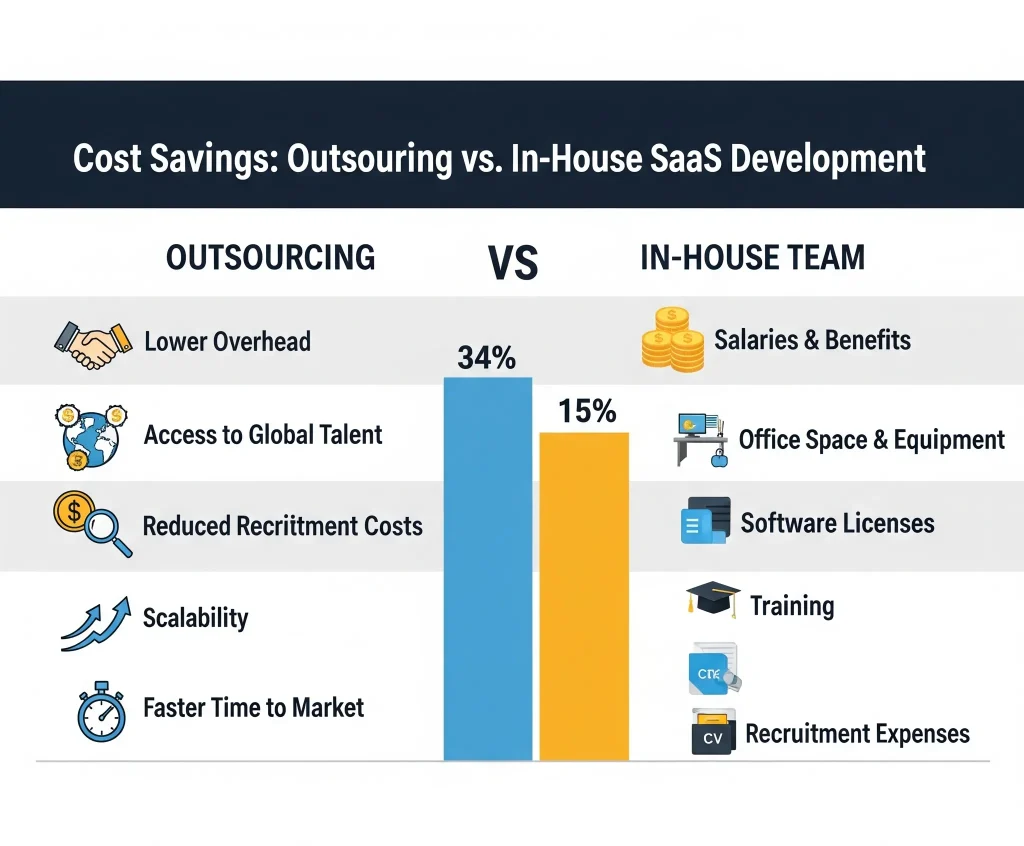
Building and maintaining a full in-house development team requires heavy investment in salaries, benefits, office infrastructure, and continuous training. By outsourcing SaaS development, companies can redirect those resources toward marketing, sales, and customer acquisition. A 2025–2026 outsourcing report by Doit Software found that 77% of businesses now outsource IT functions, spending an average of 8.1% of their budget on external technology services. This allows organizations to access enterprise-grade SaaS development capabilities at a fraction of the in-house cost.
Access to Specialized Talent in a Competitive Market
One of the strongest advantages of outsourcing SaaS development is tapping into a diverse global pool of skilled professionals. The Deloitte Global Outsourcing Survey found that 42% of executives now cite access to specialized talent as the top driver for outsourcing, overtaking cost reduction for the first time. In SaaS product development, expertise in cloud architecture, API design, multi-tenancy, and DevOps is essential—and these skills remain scarce in domestic hiring markets. Outsourcing your SaaS project bridges that gap immediately.
Faster Time to Market
Speed defines winners in the SaaS industry. Outsourcing SaaS development lets companies bypass months-long recruitment cycles and start building immediately with experienced teams that already have established workflows, pre-built modules, and industry-specific templates. In a market where the average enterprise now manages 291 SaaS applications, getting your product in front of users quickly is not a luxury—it is a competitive necessity.
Focus on Core Business Strategy
When you outsource the technical complexities of building a SaaS platform, your internal team can concentrate on strategic planning, market research, customer relationships, and business development. This separation of responsibilities creates a leaner and more focused organizational structure where every team operates within its area of strength.
Key Steps for Successfully Outsourcing SaaS Development
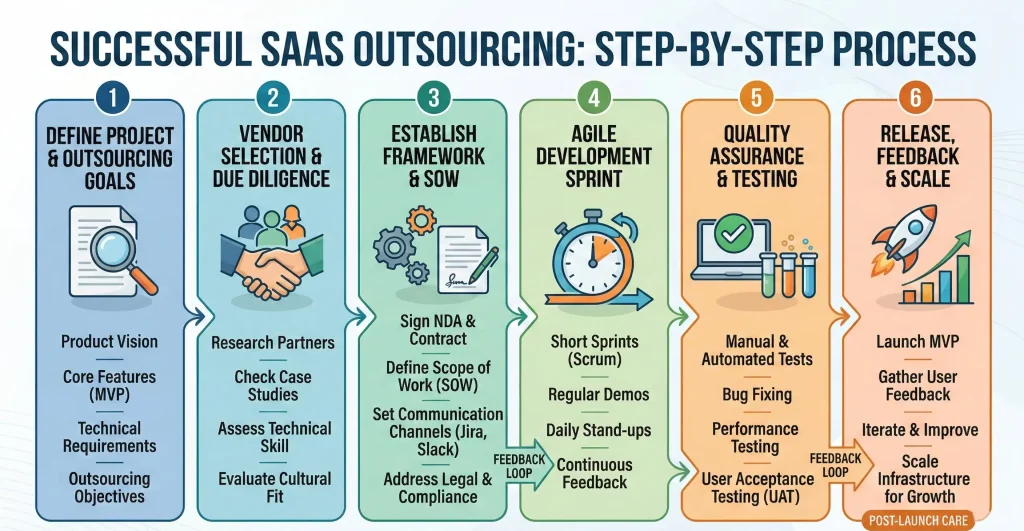
While the benefits of outsourcing SaaS development are clear, success depends entirely on a structured and well-planned approach. Here are the steps every business should follow.
Conduct Thorough Market Research First
Before engaging any development partner, deeply understand your target audience, competitive landscape, and product-market fit. Conduct user interviews, analyze competitor offerings, and validate your SaaS idea through landing page tests or prototype feedback sessions. This research will shape the technical requirements you share with your outsourcing partner and ensure the final product genuinely solves real user problems.
Define a Comprehensive Scope of Work
A well-defined Scope of Work (SOW) is the blueprint for your entire project. It should include clear project objectives, detailed functional and non-functional requirements, a realistic timeline with milestones, expected deliverables, and identified risks. Creating this document before reaching out to vendors streamlines evaluation and helps you get accurate estimates. Sharing a thorough SOW with your outsourcing SaaS development partner minimizes miscommunication and prevents scope creep during development.
Choose the Right SaaS Development Outsourcing Partner
Selecting the right partner is the most consequential decision in the entire outsourcing process. Look for a SaaS application development company with a proven track record in cloud-based software, strong communication practices, robust security measures, and a documented development methodology. At VistaSys Tech, we prioritize transparency and collaboration throughout the development lifecycle, ensuring every client receives a product that aligns with their vision and business goals.
When evaluating potential partners for SaaS development outsourcing, schedule video calls to assess cultural compatibility, review their portfolio of similar projects, and request client references. Pay close attention to how they manage projects, communicate progress, and handle challenges during development.
Adopt Agile Development Methodology
Agile methodology remains the gold standard for SaaS product development in 2026. According to the Project Management Institute (PMI), combining agile practices with SaaS delivery enables rapid and cost-effective project execution. Agile breaks development into short sprints of two to four weeks, giving your team and the outsourced partner the ability to iterate quickly based on real-time feedback. This iterative approach is essential when outsourcing SaaS development because it keeps the process transparent and gives you continuous visibility into product progress.
Common Mistakes to Avoid When Outsourcing SaaS Development

Understanding what not to do is just as important as knowing best practices. Many businesses make avoidable errors that compromise the quality, timeline, and budget of their SaaS projects.
Prioritizing Cost Over Quality
While cost savings motivate SaaS development outsourcing, choosing the cheapest vendor often leads to poor code quality, mounting technical debt, and a product that fails user expectations. Evaluate partners based on expertise, communication strength, and long-term value. A slightly higher upfront investment in a competent development partner will save you significantly in rework, bug fixes, and lost market opportunities down the road.
Neglecting Communication and Collaboration
Poor communication is among the leading causes of outsourcing failures. Establish clear communication channels from day one, define reporting schedules, and use tools such as Slack, Jira, or Microsoft Teams to maintain constant visibility. When working with SaaS development teams in different time zones, ensure there is enough overlap in working hours for real-time discussions and quick problem-solving.
Skipping Quality Assurance and User Testing
No matter which outsourcing model you choose, your internal team must stay actively involved in testing and quality assurance. Conduct usability testing, gather beta user feedback, and verify the product meets both functional requirements and user experience standards. Automated testing, CI/CD pipelines, and performance monitoring should be integral parts of your SaaS outsourcing workflow from the start.
Overlooking Post-Launch Support and Maintenance
Launching your SaaS product is just the beginning. Post-launch support—including bug fixes, feature additions, security patches, and performance optimization—is critical for long-term success. According to Zylo’s 2026 SaaS Management Index, 79% of IT leaders encountered price increases at SaaS renewals in the past 12 months, showing that users expect constant improvement and value delivery. Make sure your outsourcing contract includes provisions for ongoing maintenance and iterative improvements after the initial launch.
How to Maximize ROI When Outsourcing SaaS Development
To extract maximum value from your outsourcing investment, apply these proven strategies that successful SaaS companies use consistently.
Start with a Minimum Viable Product
Rather than building a feature-heavy product from day one, focus on a minimum viable product that solves your users’ core pain points. An MVP lets you validate your concept with minimal investment, gather real user feedback, and iteratively enhance the product based on actual data. This strategy aligns perfectly with the iterative nature of SaaS development outsourcing, where continuous feedback loops between your team and the development partner drive better results.
Invest in Robust Security from Day One
Security cannot be an afterthought in SaaS product development—especially in 2026, when AI-driven cyber threats are more sophisticated than ever. Ensure your outsourcing partner implements data encryption, secure authentication, role-based access control, and regular vulnerability assessments. With regulatory requirements like GDPR, HIPAA, and SOC 2 becoming stricter, a secure foundation from the start protects your business and builds user trust.
Plan for Scalability and Future Growth
Your SaaS product must handle growth from day one. Discuss scalability requirements with your outsourcing SaaS development partner early in the planning phase. This means choosing the right cloud infrastructure (AWS, Azure, or Google Cloud), implementing microservices architecture where appropriate, and designing databases that handle increasing data volumes and concurrent users without performance issues.
Leverage AI-Powered Development Tools
In 2026, AI is no longer optional in software development. According to Keyhole Software’s 2026 outsourcing statistics report, 83% of outsourcing teams now use AI-assisted development tools. When you outsource SaaS product development, ensure your partner leverages AI-powered coding assistants, automated testing frameworks, and intelligent DevOps pipelines. These tools improve code quality, reduce bugs, and significantly speed up delivery timelines.
The Future of Outsourcing SaaS Development
The landscape of outsourcing SaaS development is transforming at an unprecedented pace. According to Hostinger’s 2026 SaaS statistics report, 95% of organizations have now adopted AI-powered SaaS applications, and the global SaaS market is heading toward the $1.25 trillion mark by 2034. Development teams are increasingly using AI-assisted coding, automated quality assurance, and intelligent infrastructure management to deliver superior products faster than ever before.
The rise of remote and hybrid work has permanently expanded the global talent pool for SaaS development outsourcing. Nearshoring to Latin America and Eastern Europe is growing rapidly as companies seek time-zone alignment and cultural compatibility alongside technical expertise. Companies are no longer restricted to local vendors—they can partner with world-class teams anywhere on the globe, choosing based on value and capability rather than geography alone.

Conclusion
Outsourcing SaaS development in 2026 is not a cost-cutting tactic—it is a strategic growth enabler that allows businesses of all sizes to build world-class software products without the burden of maintaining large in-house teams. By conducting thorough market research, defining a clear scope of work, choosing the right development partner, and embracing agile methodology, you can transform your SaaS vision into a successful, revenue-generating product.
As the SaaS market races toward the trillion-dollar milestone, the companies that thrive will be those that leverage strategic outsourcing partnerships, prioritize user experience, and maintain a relentless focus on delivering value. The key to successful outsourcing SaaS development lies in treating your external team not as a vendor, but as a true extension of your business.
Have a project like this?
We help teams turn ideas like the one above into shipped, dependable software. Let’s talk.
Schedule a call