Custom CRM Software Development for Growing Businesses
The Competitive Edge Most Businesses Are Missing
Look at the fastest-growing companies in any industry right now and you will notice a pattern. Their sales teams close faster. Their support teams resolve issues before customers get frustrated. Their managers make decisions based on real data, not gut feeling. And when you ask them what changed, the answer is almost always the same — they stopped using a CRM built for everyone and built one designed specifically for them.
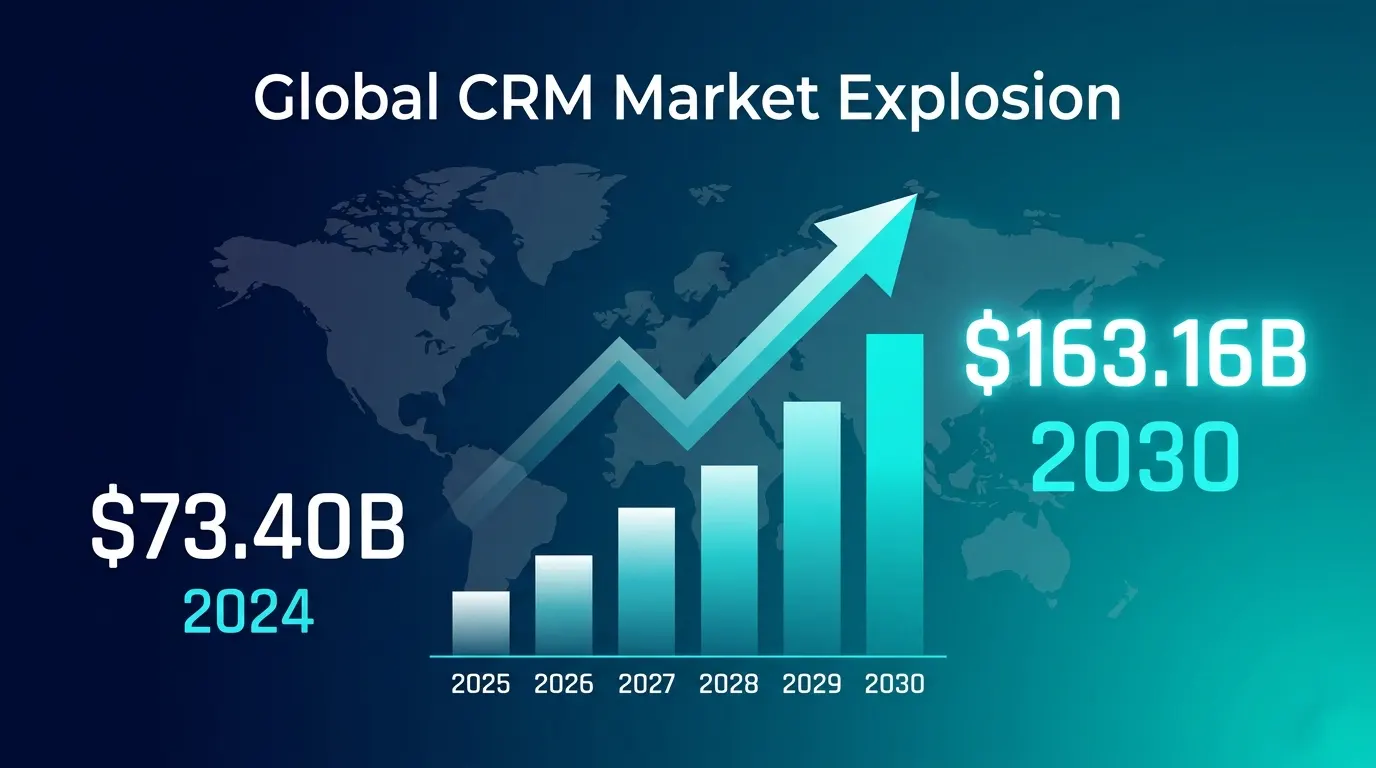
That is the secret weapon: custom CRM software development. Not a trendy tool or a new feature on an existing platform — a system engineered from scratch around how your business actually operates. According to Grand View Research, the global CRM market is projected to grow from $73.40 billion in 2024 to $163.16 billion by 2030. Businesses are not just adopting CRM anymore — they are demanding systems that fit their exact workflows, because they have seen what happens when those systems do not.
This guide breaks down what custom CRM software development actually delivers, why the CRM software benefits for growing businesses go far deeper than most people realise, and exactly how to build one that becomes a genuine competitive advantage — not just another tool your team works around.
What Custom CRM Software Development Actually Means
Custom CRM software development is the process of designing and building a customer relationship management system from the ground up — shaped entirely around your team’s workflows, your industry’s requirements, and your specific business goals. Nothing is borrowed from a template. Nothing is locked behind a higher pricing tier. You own every part of it.
Here is the reality that most vendors will not tell you: 91% of companies with more than ten employees already use a CRM. The problem is not adoption — it is fit. Most of those businesses are using platforms that technically function but quietly hold their teams back every single day. Workarounds become habits. Habits become inefficiencies. And inefficiencies compound as the business grows.
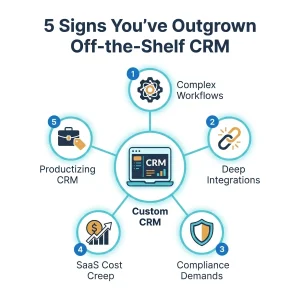
Custom development eliminates that entirely. The businesses investing in it are not doing so because they have money to burn — they are doing it because they calculated what those daily inefficiencies actually cost, and the number was uncomfortable. The move to custom CRM software development tends to happen when businesses recognise one or more of these situations:
– Sales or support processes are too specific for any off-the-shelf platform to handle without painful workarounds
– Deep integration with existing internal systems — ERP, billing, inventory, or logistics — is non-negotiable
– The business operates in a regulated industry where data handling must meet strict compliance standards
– Monthly SaaS fees keep climbing for features the team never asked for and never uses
– The company is building a CRM product to sell or license directly to its own customers
The Real CRM Software Benefits for Growing Businesses
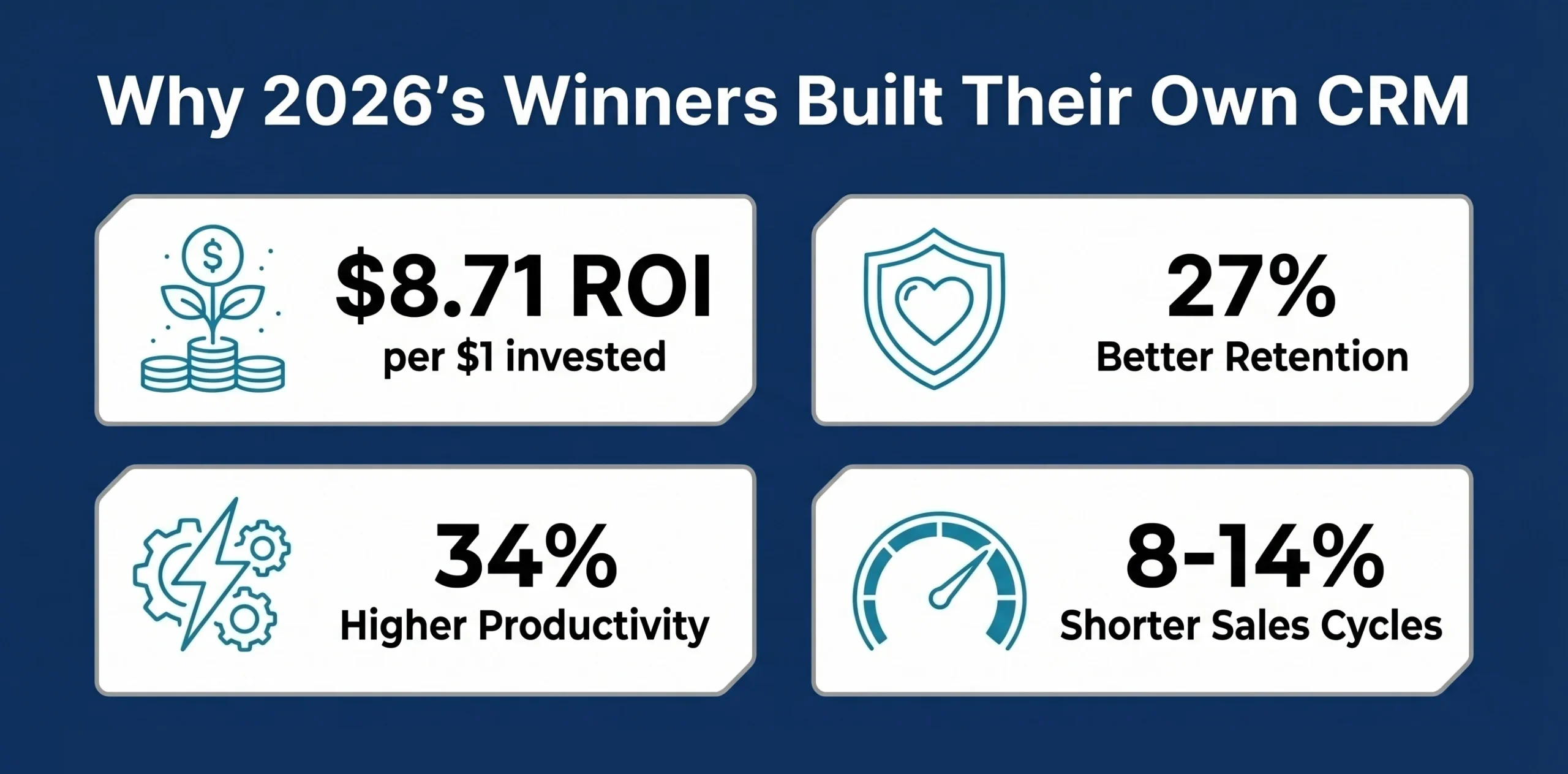
The CRM software benefits for growing businesses are not abstract. They show up in revenue, in retention numbers, and in hours your team gets back every week. According to CRM.org, businesses earn an average return of $8.71 for every $1 spent on CRM, and 97% of businesses using a CRM met or exceeded their sales goals. Those numbers come from businesses that got the implementation right. Here is what that looks like in practice:
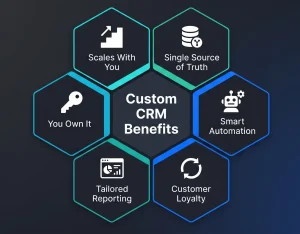
1. A system that grows when your business does
Off-the-shelf platforms are engineered for the average customer, which means they are perfect for no one in particular. Hit a user cap, need a new module, or outgrow a workflow and you are suddenly negotiating with a vendor or migrating to a new platform. A custom CRM is built to scale with you from day one — new features, more users, expanded integrations — without the disruption of a forced platform switch.
2. One place for everything your team needs to know
Customer data scattered across email threads, spreadsheets, support tools, and billing systems is one of the most invisible drains on a growing business. It slows decisions, creates gaps in customer experience, and means different departments are working from different versions of the truth. A custom CRM pulls everything into a single unified view. CRM.org reports that 53% of businesses see measurable improvements in customer satisfaction simply from consolidating their data into one system.
3. Automation that actually matches how your team works
Generic automation is built around generic processes. If your workflow does not match the template, the automation breaks and someone has to pick up the slack manually. Custom CRM software development means your automation is built around exactly how your team works — lead assignment, follow-up triggers, status updates, invoice generation, reporting. According to Salesmate, CRM-driven automation improves sales productivity by up to 34% and shortens sales cycles by 8 to 14%. That is not a marginal gain — it is a structural advantage over any competitor still on a generic platform.
4. Customer retention that compounds over time
Keeping a customer costs a fraction of acquiring a new one. A well-built custom CRM gives your team full context on every customer interaction, surfaces at-risk accounts before they churn, and enables the kind of personalised follow-up that builds genuine loyalty. Aberdeen Group research shows companies using CRM effectively see up to a 27% increase in customer retention rates. For a growing business, that improvement compounds year after year.
5. Reporting built around your business, not a template
Most CRM platforms offer reporting. What they rarely offer is reporting built around your specific KPIs, displayed the way your managers actually need to see it, without requiring a data export into a separate tool every time. A custom CRM gives you dashboards that reflect how your business measures success — not how the vendor decided to structure their default analytics module.
6. Own your system, stop renting it
SaaS pricing grows with your team. The more users you add, the higher the monthly invoice — often for features you never requested. A custom CRM is a capital investment. You build it once, you own it entirely, and ongoing costs are maintenance on your terms rather than a subscription that increases at every renewal.
Custom CRM vs. Off-the-Shelf: An Honest Comparison
Custom development is not the right answer for every business at every stage. Here is a straightforward comparison to help you decide where you stand:
| Factor | Custom CRM | Off-the-Shelf CRM |
| Upfront cost | Higher initial investment | Lower to start |
| Flexibility | Built exactly for your processes | Limited by vendor decisions |
| Integration depth | Custom APIs, connects to anything | Pre-built connectors only |
| Ongoing fees | Minimal after launch | Monthly or annual license |
| Time to deploy | 3 to 6 months typically | Days to a few weeks |
| Scalability | Grows with your business | Vendor-controlled limits |
| Data ownership | 100% yours | Shared with vendor infrastructure |
If you are early-stage with simple workflows and need something live within days, an off-the-shelf platform is a perfectly reasonable starting point. But if you are scaling, dealing with complex processes, or finding that your team spends more time managing the tool than using it — the cost of not building custom is already accumulating quietly in the background.
What to Build: The Features That Make a Custom CRM Powerful
The features in your CRM should be driven by your business requirements, not by what a vendor chose to include in their standard package. These are the building blocks that consistently deliver the most value:
Contact and lead management
A centralised, searchable database covering every prospect and customer — full interaction history, communication logs, merged data from multiple sources, all accessible from a single profile. The foundation everything else is built on.
Sales pipeline management
Visual pipeline stages with automated transitions, smart task assignments, and deal-level alerts. A well-designed pipeline makes it structurally difficult for a deal to go cold simply because someone forgot to follow up.
Marketing integration
Lead capture, campaign management, audience segmentation, and performance tracking — all feeding directly into the sales pipeline. The relationship between marketing spend and sales outcome should be visible and measurable inside the same system.
Customer support module
Ticketing, case management, and full interaction history in one place. When a customer contacts support, your team should already know everything relevant — not be asking them to explain their situation from scratch again.
Reporting and analytics
Custom dashboards tracking the KPIs your business actually cares about — conversion rates, customer lifetime value, team performance, and pipeline forecasts. For businesses that need to go deeper, pairing this with dedicated data analytics services can surface the kind of intelligence a standard CRM reporting module would never reveal on its own.
API integrations
Reliable connections to the tools your team depends on daily — accounting software, email platforms, ERP, marketing automation, logistics, and more. A CRM that cannot communicate with the rest of your stack just creates a new data silo in a different location.
Mobile access
A responsive web interface or a dedicated mobile app so your team can log calls, update deals, and access full customer context whether they are at their desk, at a client site, or travelling between meetings.
How the Custom CRM Software Development Process Works
The process does not have to be a mystery. Here is what a well-run custom CRM project looks like from the first conversation to the last handoff:
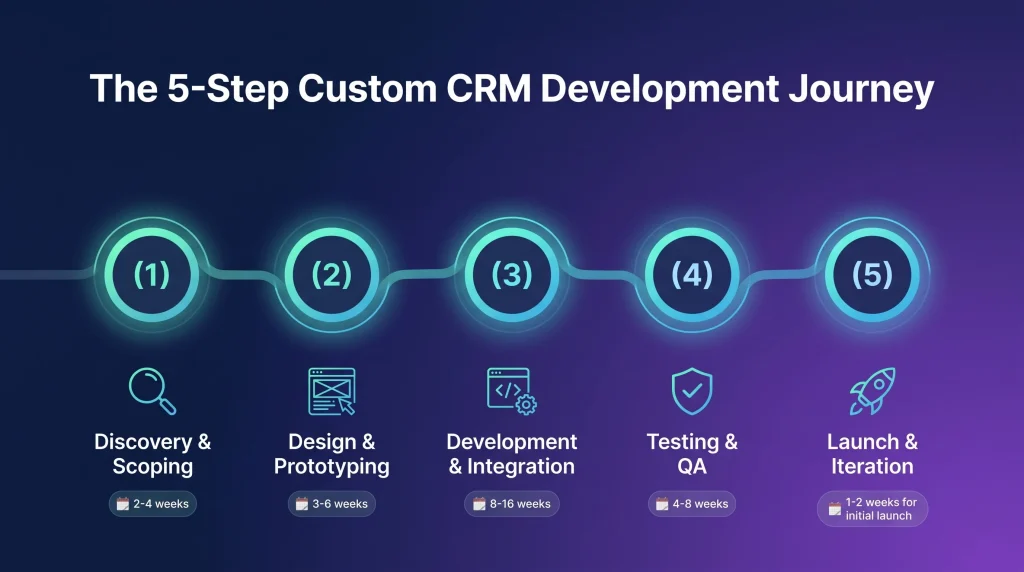
Step 1 — Discovery and scoping
This is where the real work begins and where most failed CRM projects go wrong. A good development partner spends meaningful time mapping your workflows, identifying your team’s pain points, understanding what integrations matter most, and defining precisely what a successful outcome looks like. Rushing or skipping this step is the single most common reason CRM projects go over budget or end up on a shelf.
Step 2 — Design and prototyping
The interface is fully designed before a single line of code is written. Prototypes are reviewed by your team and key stakeholders to confirm that navigation, workflows, and user journeys actually make sense in practice. Catching problems here costs a fraction of what it costs to fix them after the development phase.
Step 3 — Development and integration
Front-end and back-end development run in parallel across agile sprints, delivering working functionality incrementally so you see real progress regularly rather than waiting months for a big reveal. Teams with genuine enterprise software development experience build security and scalability into the architecture from sprint one — not as an afterthought when problems surface later.
Step 4 — Testing and quality assurance
Functional testing, load testing, security checks, and real-world usability testing all happen before launch. Every issue found and resolved at this stage costs dramatically less than the same issue found by your team after go-live.
Step 5 — Launch and ongoing iteration
Deployment, team onboarding, full documentation, and structured handoff. After launch the system should be monitored, iterated on, and expanded as your business evolves. The businesses that extract the most value from a custom CRM are the ones that treat it as a living system — not a one-time delivery.
How to Choose the Right Development Partner
The quality of your finished CRM is directly tied to the quality of the team that builds it. Here is what to genuinely evaluate before you commit:
– A demonstrated track record with CRM or enterprise software projects — not just general web development work in their portfolio
– Full-stack capability across front-end, back-end, cloud infrastructure, and API development
– A structured, thorough discovery process — partners who want to skip straight to building are a clear warning sign
– Agile delivery with regular client check-ins and working demos — not months of silence followed by a big reveal
– Post-launch support as a real, ongoing commitment — not a 30-day warranty period and then radio silence
If you want to see what a structured, engineering-led approach to custom CRM development looks like in practice, the team at vistasystech.com works with businesses from initial discovery through to long-term post-launch support — with a process built specifically to avoid the common mistakes that turn CRM projects into expensive, frustrating lessons.
The Businesses Winning in 2026 Built Their Own CRM
That is the honest takeaway from everything above. The companies outperforming their competitors in customer retention, sales efficiency, and overall team productivity did not stumble onto a better off-the-shelf tool. They made a deliberate investment in custom CRM software development — and built a system that works the way their business works, not the other way around.
The data supports it fully. CRM investment returns an average of $8.71 for every dollar spent. Customer retention improves by up to 27%. Sales cycles shorten, team productivity climbs, and the recurring SaaS fees stop compounding. The businesses using a custom CRM as their secret weapon are not doing anything extraordinary — they simply made a decision that their direct competitors have not made yet.
If you are ready to stop working around your CRM and start having it work for you, reach out to the team at Vista SysTech for a straightforward, no-pressure conversation about what building the right system for your business would actually involve.
Have a project like this?
We help teams turn ideas like the one above into shipped, dependable software. Let’s talk.
Schedule a call